
Table of Contents
ToggleClash Royale’s visual appeal is one of the game’s secret weapons. While strategy and card synergy matter, the quality of the Clash Royale 3D models is what keeps millions of players coming back for another match. From the first frame, watching your Hog Rider charge forward or a Fireball explode across the arena, every unit, structure, and spell effect tells a story through intricate 3D design. Whether you’re a casual player casually crushing Ladder matches or a competitive player grinding Crown Leagues, the polish and creativity behind Supercell’s 3D asset library directly impacts how the game feels to play. This guide dives deep into how these models work, evolve, and define the Clash Royale experience in 2026.
Key Takeaways
- Clash Royale 3D models are optimized low-poly assets that deliver visual fidelity on mobile devices without sacrificing performance, using techniques like level-of-detail rendering and texture optimization.
- The quality of 3D model design directly impacts gameplay clarity and strategy execution, helping players instantly recognize unit threats, spell effects, and board states during fast-paced matches.
- Recent unit redesigns like the Mega Knight rework demonstrate how refined 3D models improve both visual appeal and psychological player perception of card strength and utility.
- Tower skins and seasonal arena cosmetics leverage sophisticated 3D model work and particle effects to create premium monetization opportunities that justify player spending through superior artistry.
- The modding community actively extracts and celebrates Clash Royale 3D models in external rendering software and 3D printing projects, reflecting the high quality of Supercell’s asset library.
- Future trends point toward unit-specific cosmetics, AI-driven animation refinement, and expanded environmental storytelling in 3D models, building on Supercell’s nine-year commitment to visual evolution.
What Are Clash Royale 3D Models?
Understanding The Game’s Visual Architecture
Clash Royale 3D models are the digital objects that make up every visible element in the game. Think of them as the building blocks of the arena, every Musketeer, Goblin, Tower, and spell particle is a 3D asset created, rendered, and optimized for mobile devices.
These models aren’t simple flat sprites. Supercell uses a custom rendering pipeline to display complex geometry, textures, lighting, and animations on phones and tablets without tanking performance. Each unit has multiple states: idle, walking, attacking, taking damage, dying. Each state requires separate animations that blend seamlessly.
The 3D model architecture includes:
- Unit models: All 100+ cards rendered as full 3D characters
- Structure models: Towers, cannons, infernos, every defensive building
- Particle effects: Fireballs, lightning strikes, healing clouds
- Arena environments: The battlefield itself, with terrain, decorations, and destructible elements
- Cosmetic assets: Tower skins, avatars, emotes, and seasonal themed elements
Unlike PC or console games with massive budgets, Clash Royale’s 3D asset team has to squeeze visual fidelity into a constraint: running smoothly on devices from 2015 to today’s flagships. That’s the tension that makes the art direction so compelling. Supercell nailed aesthetics without bloat.
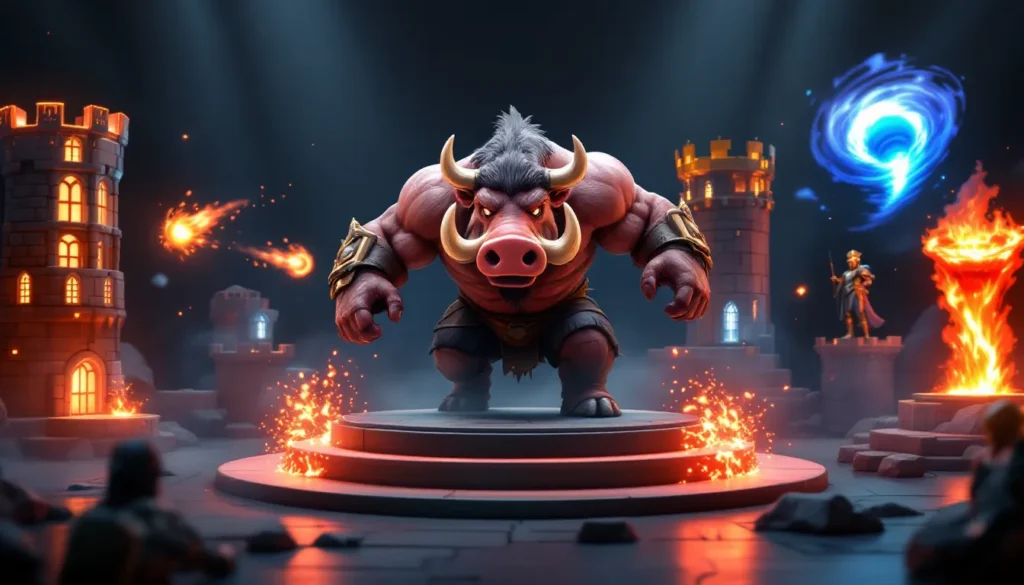
When you watch a Hog Rider barrel down the bridge with tusks gleaming, the tusks themselves are low-poly geometry, the skin has hand-painted textures, and the animation loops at 24-30 frames per second depending on your device. The whole thing is calculated in real-time on your phone. That’s Supercell’s 3D model philosophy: maximum impact, minimum overhead.
How 3D Models Enhance Gameplay Experience
Good 3D models aren’t just pretty, they make the game play better. The visual clarity of Clash Royale’s assets directly impacts your ability to read the board state, react to threats, and execute strategies.
When a Giant approaches your tower, its massive frame and towering silhouette communicate threat level before a single hitpoint is calculated. Your brain processes “big, slow, tankish” in milliseconds. A poorly modeled Giant, one that looked like every other unit, would muddy decision-making.
The color palette and distinctive shapes of each unit create instant visual recognition. Musketeer is a girl in pink. Wizard is robed with a purple staff. Inferno Dragon is red and menacing. This isn’t accidental: it’s deliberate design that reduces cognitive load during fast-paced matches.
Spell effects also reinforce gameplay clarity. Fireball explodes with red-orange particles and leaves a burn mark. Frozen slows units with blue crystalline effects. Healing Spirits swirl in green auras. The 3D particle effects act as visual language, they tell you what just happened before the chat even updates.
In 2v2 battles, where chaos is inherent, good model design prevents you from losing your own units on screen. The camera perspective, unit scale, and contrast ratios are tuned so friendly units pop visually against the background. Your Hog Rider stands out from the enemy Hog Rider because of lighting, team color tints, and animation subtlety.
The technical side matters too. Units that animate smoothly and respond immediately to input feel responsive. A Knight that doesn’t visually match its hitbox would feel broken. When a 3D model’s collision geometry lines up with its visual shape, combat feels fair. That trust is earned through precision in asset design.
The Evolution Of Character And Unit Design
Notable Design Updates And Reworks
Clash Royale’s unit roster has aged remarkably well for a game in its ninth year. But Supercell doesn’t rest on early designs. Several units have received complete visual overhauls that reflect both gameplay changes and art direction evolution.
The Mega Knight rework (2022) is a prime example. The original model looked clunky and disproportionate, huge shoulders, stubby legs. The reworked version kept the tank fantasy but refined proportions. The 3D model now looks menacing instead of awkward. The attack animation flows better. This wasn’t just cosmetic: it made the card feel stronger in the player’s mind, which matters psychologically in competitive gaming.
Executioner’s redesign took the unit from a generic axe-wielder to a distinct executioner with a mask, heavier armor, and a more imposing silhouette. The updated 3D model also improved readability, its ax swing is telegraphed better, so you can react to its deploy window more effectively.
The Tower Kings units introduced in 2023 represented a leap in character complexity. These units are far higher-poly than originals, with armor plating, dynamic cloth simulation, and more expressive animations. That was a calculated risk: would the added detail slow down phones? Supercell optimized ruthlessly to keep frame rates stable while pushing visual fidelity forward.
Older units like Archers and Goblins still retain simpler models, but that’s intentional. Not every unit needs Hollywood-level detail. Supercell reserves complex models for units that demand visual impact: Dragon, Lava Hound, Golem. The hierarchy of model complexity reflects card rarity and importance.
Recent seasonal pass emotes and cosmetics have shown even more sophisticated 3D work. Animated skins with particle trails, glowing effects, and detailed clothing wrinkles demonstrate that Supercell’s art pipeline has matured. The team learned how to layer visual effects without crushing mobile performance, a key skill as competition heats up and players demand more visual customization.
Building And Structure 3D Models
Defensive Structures And Their Visual Impact
Defensive buildings are where Supercell’s 3D model mastery shines brightest. A King Tower needs to feel authoritative. It needs to visually scream “this is your core.” The original King Tower design, a stone fortress with crenellations, glowing windows, and castle-tower proportions, still holds up today. It’s iconic.
The Princess Tower models are smaller, lighter, with more delicate stonework. They’re clearly secondary defenses. Inferno Tower has visible coils of heat and a menacing red glow. Tesla Tower hums with electrical energy. Each defensive building is modeled with enough visual personality that you never confuse them mid-match.
Tower skins layer cosmetics over this base architecture. A Lava Tower skin recolors and adds molten effects. A Holiday Tower skin drapes the building in garland and lights. These skins don’t change the 3D geometry fundamentally, that would hurt performance, but texture swaps and particle overlays create the illusion of transformation.
Other structures like Tombstone, Cannon Cart, and Bomb Tower showcase different modeling approaches. Tombstone is deceptively simple, a stone grave with a skeleton that pops out. But the skeleton’s 3D model needs to animate smoothly and feel weighty when it spawns. Cannon Cart is more complex: a moving structure with wheels, a cannon that rotates, and destruction states as it takes damage.
Spell Effects And Animated Elements
Spell effects are pure 3D artistry combined with particle physics. Fireball isn’t just a red circle, it’s a 3D projectile that flies through space with rotation and scaling, then explodes into cascading particles that fade over time. The flame particles have physics: they rise, expand, and dissipate realistically.
Tornado spawns a 3D vortex effect that swirls units. The model itself is invisible, it’s purely particles arranged in a cone that rotates and pulls. Behind the scenes, the particle system calculates hundreds of individual emitters creating the illusion of a cohesive force.
Lightning chains between units with 3D lightning arcs (not flat sprites). Heal Spirit trails are 3D curved paths with particle emission along the route. These effects demand sophisticated 3D math to calculate positions, rotations, and opacity over time.
Spell effects also serve a critical gameplay function: they communicate to both players what just happened. When your Rocket lands, the 3D explosion model and particle burst confirm it hit. Without that visual feedback, the game would feel unresponsive.
Recently, Supercell added animated spell icons in the match UI that are 3D spins of the actual 3D model. When you tap Fireball from your hand, the card shows a rotating 3D fireball. This unified visual language, where UI and gameplay match, reinforces the game’s cohesion.
Customization And Cosmetic 3D Models
Avatar Skins And Character Customization
Clash Royale’s cosmetic economy revolves around 3D models. Every avatar, from Barbarian King to Archer Queen, is a full 3D character with multiple variants through skins. A Dark Prince avatar might have a royal skin with fancier armor, a spooky skin with skull details, or a summer skin with casual clothing. Each is a distinct 3D model layered over the base.
Avatar customization goes deeper than just appearance. Animated cosmetics add 3D particle effects: glowing auras, trailing smoke, magical swirls. A Dragon-themed avatar might breathe fire particle effects. A Winter avatar might have snow constantly falling around it. These effects are rendered in real-time, adding to the overall visual spectacle.
The 3D model quality of cosmetics has increased significantly. Early cosmetics were simple texture swaps. Modern cosmetics feature unique geometry: different armor shapes, new weapon models, distinct silhouettes. This pushes the mobile rendering pipeline, but Supercell has optimized enough that even mid-range devices handle it.
Cosmetics also offer a monetization angle, and this drives continued investment in 3D model quality. Players are willing to spend money on cosmetics that look undeniably better than defaults. A shiny golden skin with reflective materials looks better than a matte original. That visual quality difference, driven by superior 3D modeling and material work, justifies the price point.
Tower Skins And Arena Aesthetics
Tower skins are some of the most visible cosmetics. Because towers are centerpieces of your arena, a royal skin or legendary skin transforms the entire battlefield aesthetically. A Dark Tower skin repaints your King Tower in gothic blacks and purples. A Fire Tower skin adds molten textures and flame particle effects.
Tower skins don’t change gameplay, they’re purely visual, but psychologically, they matter. Playing with a tower skin you love feels better. It’s personal expression within the constraints of a competitive game.
Arena themes take tower skins further. Seasonal arenas retheme the entire environment: ground textures, background mountains, emote poses, even the elixir bar color scheme. A Lava Arena colors everything in reds and oranges, with glowing cracks in the ground. A Frozen Arena blankets everything in snow, with icy blue tones. These 3D environments aren’t just backgrounds: they’re carefully crafted visual spaces designed to feel cohesive with the tower skins and unit cosmetics.
The arena itself is a 3D model with layers: terrain, destructible rocks, trees, background elements. Seasonal updates swap out geometry and textures to match themes. A Haunted Arena might add ghost 3D models floating in the background (non-interactive, purely atmospheric).
Cosmetic monetization through 3D models has become Supercell’s primary revenue stream. Unlike pay-to-win mechanics, cosmetics are pure personalization, and the team invests heavily in 3D asset quality because that’s what players see and judge. A gold-layered skin with premium materials (reflective shaders, complex geometry) commands a premium price.
How To Access And View 3D Models
In-Game Model Viewers And Tools
Supercell added an official 3D model viewer in-game around 2023. From the card collection menu, you can tap any unit and see a rotating 3D preview. This isn’t just cosmetic, it lets players inspect card details, check out skins they haven’t purchased, and examine cosmetic variations.
The in-game viewer is intentionally limited for performance reasons. It shows the unit in isolation, rotating on a neutral background. It doesn’t show the full complexity of how models look in actual match conditions, lighting, other units nearby, motion blur during attacks. But it gives a solid preview.
Some players use the in-game viewer to compare unit designs. A newer unit like Electro Dragon has more detailed 3D geometry than older units like Bomber. By rotating them side-by-side in the viewer, you can observe the art direction evolution.
The emote menu similarly previews 3D emote animations. Animated emotes are 3D character or object models playing sequences. A laughing emote shows your avatar’s 3D model with laugh animation. These previews help justify the cosmetic cost.
Fan-Made Model Resources And Communities
Outside the game, fan communities have extracted and shared Clash Royale’s 3D assets. Modding sites like Nexus Mods host model files that enthusiasts have ripped from the game. These fan projects let players view 3D models in external software like Blender or Unity.
The modding community treats Clash Royale model ripping as a form of appreciation. Fans create high-quality renders, screenshots of 3D models in custom lighting and backgrounds far superior to in-game views. A beautifully lit render of Goblin Giant in Blender might showcase details the game never shows due to camera distance and arena lighting.
Some fans use extracted models for 3D printing. Yes, people 3D-print Clash Royale units. A Wizard 3D model becomes a physical figurine through this pipeline. Supercell hasn’t aggressively shut this down because it’s positive fan engagement and not commercial competition.
Discord communities dedicated to Clash Royale art aggregates these fan renders. r/ClashRoyale on Reddit regularly features fan-made artwork, some using the extracted 3D models as references. These communities celebrate Supercell’s art direction by studying and recreating it.
Fan wiki sites document every cosmetic ever released, often with high-quality screenshots of each skin. Players planning cosmetic purchases reference these wikis to see exactly how a skin looks in-game before spending gems. The combination of official in-game viewers and fan documentation creates a comprehensive library.
The Technical Side: Rendering And Optimization
How Supercell Optimizes Models For Mobile
Clash Royale runs on devices from budget Android phones to latest-gen iPhones. That range demands brutal optimization. A Lava Hound’s 3D model might have 10,000 polygons on PC but 800 on mobile. Supercell creates multiple levels-of-detail (LOD) versions for every asset.
At distance, units use lower-poly models. A Hog Rider far from the camera uses fewer polygons. Up close, the model switches to higher-detail geometry. Players never notice because the swap is algorithmic, cameras rarely focus on distance units anyway.
Textures are optimized aggressively. Instead of 2K or 4K textures like console games, Clash Royale uses 512×512 or 1024×1024 textures, sometimes smaller. But through careful material craftsmanship, normal maps, specular maps, ambient occlusion bakes, these lower-res textures look rich. A Royal Hog’s metal armor gleams even though texture resolution being a limitation.
Shader optimization is critical. Supercell uses custom shaders that batch draw calls efficiently. When multiple Goblins attack, they don’t each require separate rendering passes. Instancing techniques render dozens of identical units in one operation. That’s how a clash with 20+ units on-screen stays playable.
Lighting is baked or approximated rather than computed in real-time for every pixel. Shadows are pre-calculated. This sounds restrictive, but artists work within these constraints creatively. The lighting in Clash Royale, warm in some arenas, cool in others, is carefully authored to feel dynamic even though technical limitations.
Particle effects use pooling and recycling. When a Fireball explodes, the particles aren’t newly allocated: they’re pulled from a pool of pre-allocated particle instances and reused. This reduces garbage collection stutters that would otherwise tank frame rates.
Supercell also profiles performance obsessively. Every balance patch, every cosmetic release, every UI update goes through performance testing on a range of devices. If a new cosmetic would cause frame drops, it gets optimized before release. This dedication keeps even old devices running smoothly, which is why Clash Royale remains accessible across the device spectrum.
The recent introduction of 60 FPS mode on supported devices required reimagining animation timings and particle speeds. At 60 FPS, subtle details become visible that weren’t animated at 30 FPS. Attacks look sharper, movement feels snappier. But supporting both 30 and 60 FPS code paths adds complexity. Supercell’s willingness to iterate on rendering tech shows commitment to visual evolution.
Future Trends In Clash Royale’s Visual Design
Clash Royale’s 3D model direction in 2026 points toward increased customization and environmental storytelling. Recent leaks and official teasers suggest Supercell is exploring unit cosmetics beyond tower and arena skins. Imagine purchasing a skin that changes how a specific unit looks mid-match. A Golden Barbarian skin might make your Barbarian flash gold every time it attacks.
Environmental props suggest another trend. Rather than just swapping textures, seasonal arenas might introduce 3D interactive elements, destructible objects, visual hazards, or aesthetic set pieces that react to spell impacts. A Candy Cane Pinecone environment might have actual 3D candy decorations that your spells visually affect.
AI-driven animation refinement could emerge as a focus. Instead of hand-animating attack sequences, machine learning might help artists generate smoother transitions between animation states. This could enable more fluid, lifelike unit movements while reducing animation overhead.
The competitive esports scene is also pushing visual demands. Broadcast tournaments need spectator modes with better camera control and 3D model clarity. Supercell may invest in a high-fidelity 3D rendering pipeline specifically for esports broadcasts, separate from mobile constraints.
Cross-game cosmetics between Clash Royale and sister games (Clash of Clans, Brawl Stars) could leverage shared 3D asset libraries. If a Dragon unit appears in multiple games, Supercell might develop one high-quality 3D model and adapt it across platforms. This would improve consistency and reduce art team overhead.
The industry trend toward HD remastering older mobile games suggests Clash Royale might eventually receive a graphics overhaul. Imagine a legacy mode with updated 3D models, modern shaders, and high-res textures. That’s far off, but not impossible given Supercell’s resources.
For competitive players, visual clarity will remain paramount. As the meta evolves, unit designs that clearly communicate role (tank, DPS, utility) will matter psychologically. Supercell will likely continue refining 3D silhouettes to improve readability in chaos.
Meanwhile, spending on cosmetics will keep growing. Players now expect cosmetic depth, multiple skins per unit, animated variants, exclusive seasonal cosmetics. The 3D model pipeline that supports this monetization will only expand. Hiring more artists, investing in better tools, and building larger asset libraries are all trends we’ll see continue into 2027 and beyond.
Conclusion
Clash Royale’s 3D models are far more than decoration. They’re the visual language through which millions of players experience strategy, competition, and customization. From the iconic King Tower to the tiniest Goblin, every asset is engineered for both artistic impact and mobile performance, a balance few games achieve as elegantly.
The evolution of these models over nine years reflects Supercell’s commitment to visual quality. Reworks like the Mega Knight redesign prove the team iterates relentlessly. The sophistication of modern cosmetics shows how monetization and artistry can align. And the technical optimization underpinning it all demonstrates that constraints breed creativity.
Whether you care about cosmetics or just want to understand why your units look the way they do, the 3D model foundation matters. It shapes how you read the board, how you react to threats, and eventually, how you experience Clash Royale. As 2026 unfolds and new cosmetics arrive, these models will continue evolving, but the core philosophy remains: maximum beauty, minimum overhead, and pure joy in every frame.


