
Table of Contents
ToggleThe Princess Tower in Clash Royale is one of the most deceptive defensive structures in the game. From behind your arena walls, this ranged defender dishes out steady damage across an impressive range, but understanding its mechanics is the difference between holding the line and watching your tower crumble. In 2026’s meta, ladder play has evolved dramatically, and knowing how to leverage your Princess Tower both defensively and as a pressure point can shift matches in your favor. Whether you’re grinding through midladder or pushing toward 7000 trophies, mastering Princess Tower strategies is non-negotiable. This guide breaks down everything you need to know about placement, timing, elixir management, and synergy to turn your Princess Tower into an unbreakable fortress, or a launching point for devastating counter-pushes.
Key Takeaways
- Princess Tower in Clash Royale has a 9-tile attack range and deals 21.9 DPS, making it a deceptively effective defensive asset that contributes significant chip damage across extended matches.
- Optimal troop placement—intercepting threats at the bridge rather than near the tower—maximizes elixir efficiency and prevents Princess Tower destruction.
- Mastering Princess Tower destruction requires balancing ranged damage dealers (Musketeer, Firecracker) with tanks (Giant, Golem) to create pushes that both soften and eliminate the opposing tower.
- Efficient card cycling and hand prediction allow skilled players to apply consistent Princess Tower pressure every 20–25 seconds, accumulating 1500–2000+ damage by mid-game without heavy elixir investment.
- Princess Tower health should be treated as a secondary win condition in the opening and middle game phases, with damage naturally accruing from successful counter-plays and optimized pressure rotations.
- Reading opponent elixir efficiency and defensive card cooldowns—such as Tornado (15–20 second rotation) and Log (12–15 second rotation)—reveals windows for maximum Princess Tower chip damage.
Understanding Princess Tower Mechanics and Range
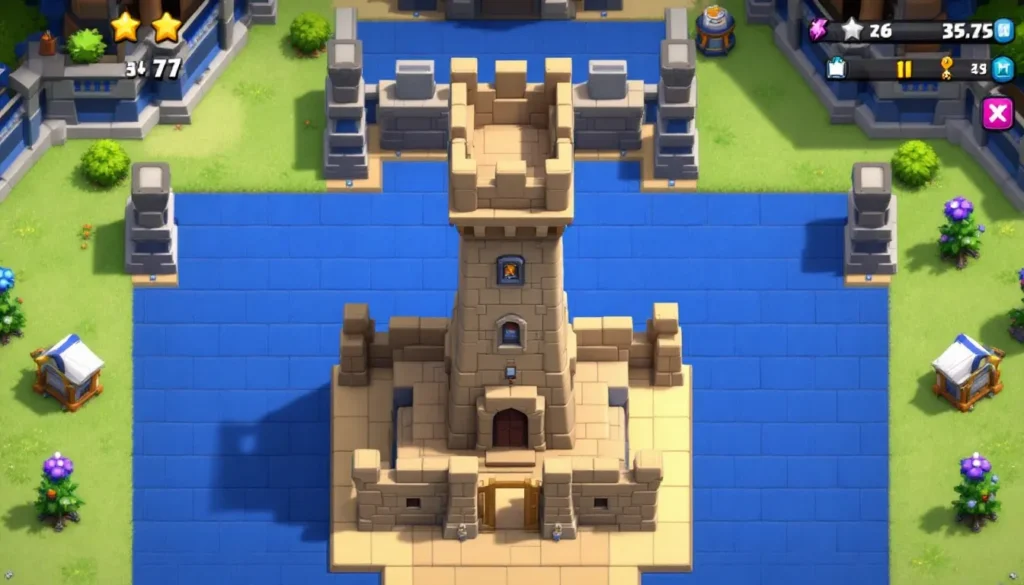
The Princess Tower is your first line of defense, perched on the edge of your arena. It fires arrows and boasts a range that extends beyond most ground troops’ effective distance. This unique positioning gives it massive coverage advantages, but only if you understand the exact range and what it can and can’t handle.
Princess Tower Attack Range and Coverage
The Princess Tower’s attack range sits at 9 tiles, making it one of the longest-range structures in the game. In practical terms, this means it can attack units on the opposite side of the arena from its position, a capability that’s crucial for shutting down early rushes before they gain momentum.
The range is measured from the tower’s position to the target’s position. When opponents deploy cheap cycle decks with cards like Goblins or Skeletons, your Princess Tower starts dealing damage the moment they cross the halfway mark on the bridge. This range advantage is what makes Princess Towers so valuable for trading elixir early in the match.
But, the range has a blind spot directly below the tower where melee troops can plant themselves relatively safely. Troops like Hog Rider can rush in and deal serious damage before the tower gets in meaningful shots. Understanding this weakness is critical for your defensive planning.
One often-overlooked aspect: the Princess Tower can and will target air units within range. This makes it somewhat useful against Balloon, Bats, or early Goblin Barrel threats, though dedicated air defenses like Inferno Dragon or Tornado are still necessary for real aerial pressure.
Damage Output and DPS Comparison
The Princess Tower deals 35 damage per hit (as of current balance), with an attack speed of 1.6 seconds. This translates to roughly 21.9 DPS when unimpeded. On paper, that sounds modest, but the consistency and range make it deceptively effective at chip damage and trading.
For context, a level 13 Princess Tower deals more cumulative damage over a 10-second period than many mid-elixir troops can output in the same window. What makes this relevant is the passive nature of the damage. While opponents are pressuring your king tower, your Princess Tower is firing automatically, softening threats without requiring your input.
Compare this to a Musketeer (70 damage per hit, 1 attack speed) and you see the trade-off: Musketeer hits harder but is significantly more fragile and vulnerable to ground swarms. The Princess Tower, meanwhile, sits safely behind walls and can handle multiple targets with arrows that splash for minor AoE.
Against common ladder pushes, Hog Rider, Mini P.E.K.K.A, or Royal Giant, the Princess Tower’s contribution is meaningful but never a solo solve. You’ll always need supporting defenses, but that consistent chip damage means less pressure on your king tower and more breathing room for counter-plays.
Defensive Strategies: Protecting Your Princess Tower
Your Princess Tower is valuable, but it’s also vulnerable. Once opponents recognize they can bait out your defenses and target it directly, they’ll pivot their strategy. Protecting it requires smart troop placement, read prediction, and proactive pressure.
Optimal Troop Placement for Tower Defense
Troop placement determines how quickly threats reach your Princess Tower and how much damage you take in the exchange. The goal isn’t always to keep it pristine, it’s to maximize the elixir trade while minimizing their push’s momentum.
When facing a bridge-crossing threat like Hog Rider, place your counter-troop at the bridge rather than near the tower. A Musketeer placed at the bridge intersects the Hog’s path earlier, giving it more time to attack before the Hog reaches the tower. A Knight placed in the center responds to both lanes. This positioning principle, intercept before tower interaction, applies to most ground pressure.
For ranged threats (Ranged troops or spells), the placement rules shift slightly. Archers or Firecracker pushed down a lane will inevitably get a few hits on your Princess Tower. Your goal becomes minimizing their damage window by placing a counter-troop same-lane, same-level to force an equal trade or create a skirmish before spell rotation.
One underrated tactic: stacking defenses at the center. Placing a Knight in the middle lane with a small ranged support (Archer, Musketeer) creates a unit cluster that covers both lanes of incoming pushes. This formation buys time and forces opponents to spread elixir across both sides to maintain pressure, often not worth it early on.
Against air units, your Princess Tower provides minimal real defense. Troops like Balloon or Dragons need dedicated air counters. Place Inferno Dragon or Tornado users anticipating the air push rather than reacting after the threat is already targeting your tower.
Counter Plays Against Common Push Strategies
The ladder is predictable if you know what’s coming. Most meta decks employ one of a few core push archetypes, and understanding the optimal response per archetype saves elixir and frustration.
Hog Rider + Support: The Hog is the most common bridge threat. A Hog without support (splash) dies to a Knight + small ranged unit combo in 4-5 seconds, taking minimal hits on the tower. When support cards (Zap, Tornado) accompany the Hog, your response needs a spell-resistant counter. Ice Golem or Skeletons placed at the bridge, followed by tower chip, often baits the opponent’s Zap, leaving them vulnerable for your counter-push.
Giant Push: Giants are slow but tanky. Placing multiple small units (Goblins, Skeletons) to swarm the Giant while a ranged unit (Archer, Musketeer) focuses fire is the classic response. The Princess Tower’s chip damage is significant here, a Giant takes roughly 20 tower hits to die, meaning the tower contributes ~700 damage (at level 13) to the kill.
Mini P.E.K.K.A. + Knight Support: This is a raw damage push. Your Princess Tower barely tickles this combo. A Tornado from Tornado users (or another pull card) placed at bridge disrupts the formation and buys time. Alternatively, Skeleton Army placed slightly behind the tower forces the Mini P.E.K.K.A. to cleave them down, delaying the tower damage by 5+ seconds, enough for a counter-push setup.
Balloon at Bridge: Balloons require air defense or ground defense with a knockback mechanic (Tornado, Logs). Placing a Musketeer or Inferno Dragon at the bridge preemptively stops the Balloon before it reaches tower range. Waiting for the Balloon to cross the center means eating 200+ damage before your defense engages.
The unifying principle: read your opponent’s elixir and anticipated push, then position your defense to intercept the maximum damage before it reaches your tower.
Offensive Pressure: Princess Tower Destruction Tactics
While your Princess Tower defends, you need ways to chip it down when you’re attacking. Building pushes specifically designed to target Princess Towers, rather than just swinging through the lane and hoping for damage, separates good players from great ones.
Building Winning Pushes to Damage Princess Towers
Princess Towers sit far back, making them safe from low-cost units. Units like Goblins or Skeletons reach the tower but take forever to destroy it. Conversely, high-powered single-target troops (P.E.K.K.A, Mini P.E.K.K.A) delete Princess Towers but are slow and vulnerable to swarms.
The optimal push balances reach and DPS. A common pattern: deploy a tank (Giant, Golem, Royal Giant) in the center, followed by a ranged damage dealer (Musketeer, Firecracker, Magic Archer) or splash unit (Wizard) beside it. The tank absorbs aggro from the opposing tower and ground defenses while your DPS troops melt the Princess Tower.
Example: Giant + Musketeer at 12 elixir is a slow but effective Princess Tower killer. The Giant walks forward for 8-10 seconds while the Musketeer fires. Against zero defense, the Princess Tower dies in roughly 8-10 seconds of Musketeer damage (assuming level-matched cards). In real matches, opponents counter, so your setup time extends, but the principle holds: layered offense with both tank and damage dealer creates a push that’s flexible and hard to stop.
Another key concept: split pushing. Instead of committing all elixir to one lane, send a small threat (Hog Rider, Goblin Barrel) down one lane while saving elixir for a real push in the other. This forces opponents to spread defense. If they commit both defenses to the Princess Tower lane, your split push hits the king tower or second Princess Tower for chip damage.
Timing matters enormously. Pushing immediately after an opponent has spent heavy elixir on defense is textbook ladder play. If they just used Tornado + Musketeer to stop your Hog, they’re low on elixir. A well-timed Golem push on the other side now faces minimal defense, and you damage their Princess Tower significantly.
Elixir Management for Sustained Pressure
Creating constant Princess Tower pressure without bleeding elixir is the hallmark of skilled ladder play. This requires cycling efficient cards and knowing when to apply pressure versus when to defend.
Efficient pressure cards like Hog Rider (5 elixir) or Goblin Barrel (3 elixir) take chips off the Princess Tower every cycle. If you’re cycling Hog Rider every 20-25 seconds and your opponent has limited answers in rotation, you’re gaining a cumulative advantage. Each Hog deals 150+ damage: ten Hogs across a match is 1500 damage without a major push, often enough to take a Princess Tower to 50% health.
The trap many players fall into: over-committing to offense and leaving themselves defenseless. Ladder play requires balance. A good rule of thumb is maintaining at least one defensive card in rotation at any time. If you’re cycling Hog + Fireball offensively, keep an Archers or small unit available for emergency defense.
Elixir advantage on the ladder is temporary, it resets every 10-15 seconds. But, using your elixir with higher efficiency compounds. Spending 5 elixir on a Hog Rider that deals 200 chip damage to the Princess Tower is a +1 trade if the opponent spends 6 elixir to stop it. Stack these trades, and you’ll have a Princess Tower at half health by the 2:00 mark with roughly equal total elixir spent, a significant positional advantage.
Deck Building With Princess Tower Synergy in Mind
Your deck determines which Princess Tower strategies are viable. Some decks excel at passive Princess Tower defense while others are built to obliterate opponent towers through coordinated offense.
Supporting Cards for Tower Destruction
Cards synergize with Princess Tower offense in two ways: they enable tower destruction, or they help the setups that unlock it.
Direct Synergy (Damage Dealers):
Musketeer, Firecracker, Magic Archer, and Wizard are the core Princess Tower damage dealers. They pair with tanks to apply consistent pressure. If your deck lacks these, Princess Tower damage becomes reliant on single-target troops (P.E.K.K.A., Mini P.E.K.K.A.), which are slower and spell-vulnerable.
Enabler Cards:
Rage, Elixir Golem, and cards that buff your units or sustain pressure directly amplify Princess Tower offense. A Raged Hog Rider cycle is substantially scarier than a normal one. Elixir Golem + Hog hybrid decks create dual threats that spread opponent defense thin.
Spells also matter. Fireball or Poison used on defending troops shifts the elixir trade, leaving your Princess Tower pressure uncontested. Tornado pulls defenses away from your pushes, allowing your troops to reach the tower faster.
One underutilized synergy: cycle consistency. Decks with short average elixir cost (sub-3.5) cycle cards faster, allowing repeated Princess Tower threats before opponents fully reset their hands. Bait decks with Goblins, Goblin Barrel, and spell bait excel here. The Princess Tower takes constant poke damage while opponents manage spell rotations.
Meta Deck Archetypes and Princess Tower Pressure
The current meta (2026) has settled into a few dominant archetypes, each with distinct Princess Tower strategies.
Hog Cycle Decks are the gold standard for Princess Tower chip damage. Hog Rider + Knight + Musketeer + Goblins creates a flexible skeleton that applies both defensive and offensive pressure. Hog Rider can cycle every 20-25 seconds, guaranteeing regular Princess Tower hits. Check the Clash Royale Top Decks guide for current Hog Cycle variations and which supporting cards are trending.
Golem Push Decks are heavier and focus on one or two massive pushes per game. These decks spend 15+ elixir on a single push but obliterate Princess Towers if they connect. The downside: if you defend the push efficiently, the Golem player is vulnerable for 20+ seconds. These decks require careful Princess Tower damage scaling throughout the game so a single Golem push closes it out.
Bait Decks (Goblin Barrel focus) work via repeated small-chip offense. Goblin Barrel lands 3-4 times per game, and each hit damages the Princess Tower. Defending Goblin Barrel is low-elixir (Log or Zap), so bait players leverage spell cycling to avoid your spells and ensure Goblin Barrel connects reliably.
Beatdown Decks (Giant, Royal Giant, Elixir Golem) require more deliberate Princess Tower offense. These decks are tank-heavy and struggle with cycle pressure. Princess Tower damage comes from secondary units (Musketeer, Wizard) in the push itself.
To pick the right deck, ask: What Princess Tower pressure pattern do I want to employ? Consistent chip damage (cycle), burst damage (beatdown), or spell-based disruption (bait)? Your deck structure follows from that choice. Exploring the Deck Clash Royale guide helps identify which archetypes align with your playstyle.
Princess Tower Versus King Tower: Priority and Trade-offs
Here’s a tough question: when should you ignore Princess Tower damage and focus on the king tower instead? This priority question shapes your entire matchup approach.
The Princess Tower sits behind walls at the back of your arena. The king tower, meanwhile, is centrally located and easier to reach. From a pure positioning standpoint, the king tower is more vulnerable.
But, destroying the Princess Tower first is often the stronger strategic play. Here’s why: the Princess Tower generates continuous chip damage across the entire arena. Every unit that pushes down its lane for the next 5 minutes takes Princess Tower poke damage. That adds up. If the Princess Tower is still alive at 1:00 remaining, it’s dealing 10-20 chip damage per cycle to your remaining push cards. Over a game, a healthy Princess Tower easily adds 500-1000 cumulative damage to your total tower damage, effectively giving you a near-free partial tower for the course of the game.
The exception: in the final minute of a match, king tower is the priority. If the match is going to overtime or you’re behind on time, don’t waste cycles on Princess Tower damage. Push the king tower directly and race for the three-crown.
In the opening 3-4 minutes, follow this hierarchy:
- Defend and counter-push (your primary job)
- Chip the Princess Tower (if your counter-push naturally hits it)
- Cycle for the next major push (maintain elixir advantage)
Think of Princess Tower damage as the dividend from successful defense and counter-plays, not a primary objective. If you’re winning trades and generating counter-pushes, the Princess Tower naturally takes damage. You’re not contorting your deck or strategy just to hit it, you’re positioning your efficient counters and pressure cards to do double duty.
One nuance worth mentioning: if a Princess Tower is already below 50% health, pushing for the final elimination is high-value. A destroyed Princess Tower is gone: a weakened one is still annoying. Conversely, if the opponent’s Princess Tower is at 85%+, hitting it with a chip-heavy push is low-efficiency. Better to save elixir and optimize your card rotation for stronger pressure later.
Advanced Tips for Maximizing Princess Tower Advantage
Once you’ve mastered the fundamentals, advanced concepts separate consistent ladder grinders from players pushing toward ultimate ladder ranks. These tactics hinge on prediction, hand reading, and micro-level timing.
Cycling Tactics and Timing Your Pushes
Cycling refers to playing cards in a sequence such that your key threats rotate back to your hand faster. A simple example: if your deck has Hog Rider and you play it every 20-25 seconds, you’re “cycling Hog.”
Princess Tower offense becomes devastating when you optimize cycling. If you’re playing a Hog Cycle deck with a 3.2 elixir average, you recycle to another Hog approximately every 20 seconds. By the 3:00 mark, you’ve had 9 Hogs cycle through your hand (accounting for draw time and opponent defense). That’s 1800+ chip damage to the Princess Tower from a single card, often representing 30-40% of the tower’s health.
To maximize cycling efficiency, use your cheap cards as spacers. If Hog is your pressure card but it rotates back to your hand slowly due to placement hesitation, fill the gap with Goblins or Skeletons. These cards also apply pressure and cycle faster, keeping your hand rotation smooth. A smooth hand rotation means you’re never waiting for Hog: it’s always there when you need it.
Timing your bigger pushes around elixir disadvantages is critical. After you’ve cycled 3-4 small-pressure cards (Hogs, Goblins), you’ve probably built a 2-3 elixir advantage. That’s the moment to deploy your king-tower-focused push if the opponent has wasted elixir on defense or cycling. The Princess Tower is still taking chip damage from your earlier cycles, and now you’re escalating the threat.
Another advanced tactic: intentional misplays for read info. If you place a Musketeer in the center and it walks toward the opponent’s king tower, you’re gathering information about their defense options. Do they Tornado it away? Swarm it? Their response tells you what they’re holding and shapes your next move. This read-based cycling is what separates 6000-trophy players from 7000+.
Reading Opponent Hands and Predicting Defense
Ladder play is 70% resource management and 30% hand prediction. Predicting what your opponent has allows you to sequence your pushes around their defenses and maximize Princess Tower damage.
Start with card rotations. After your opponent plays their first 10-12 cards, you have a rough idea of their deck. Count the types: have you seen Zap, Fireball, and Tornado? Do they have a Musketeer yet? Are they running a Hog or Beatdown push? As the game progresses, you narrow down which cards are still in their hand based on what they’ve played and when.
Second, observe their elixir efficiency. If your opponent has been defending efficiently (spending 5 elixir to stop your 5-elixir pushes), their elixir is roughly equal to yours. Pushing into an equal-elixir situation is low-value: wait for them to overspend. Conversely, if they just defended a push with heavy elixir (8+ spent on a single defense), they’re vulnerable. Push immediately.
Third, bait their answers. If you suspect they have a Tornado, send a Musketeer alone into their lane to draw it out. Once Tornado is on cooldown (roughly 15-20 seconds), you push with a Musketeer-supporting unit knowing they lack the disruption. This bait-cycle play is exhausting for opponents and creates openings for Princess Tower-decimating pushes.
On ladder, common defensive cards have predictable rotations. Tornado users typically have it back every 15-20 seconds after use. Log players have it back every 12-15 seconds. If you can identify when a key defense card is unavailable, that’s your window to apply maximum Princess Tower pressure.
One more tool: defensive positioning as information. If your opponent places all their defenses in the center lane, they’re predicting a center push and possibly indicating that lane has heavier defense built-in. Consider splitting your pressure to their other lane where defense is lighter. Conversely, if they’re spread thin, a concentrated center push often breaks through.
Resource reading and prediction require practice, but the payoff is enormous. Players who read hands well generate 2000+ Princess Tower damage per game through optimized, pressured attacks. Players who don’t often settle for 1000-1500, relying on opponent mistakes rather than strategic execution.
Conclusion
Mastering the Princess Tower in Clash Royale is about understanding its dual role: a passive defensive asset that trades efficiently, and a target that must be systematically damaged across the course of a match. The nuances are deceptively deep, from range mechanics and troop placement, to elixir cycling and hand prediction.
In 2026’s ladder meta, players who treat the Princess Tower as a secondary win condition rather than a set-it-and-forget-it defense consistently climb faster. You’ve learned that Princess Tower offense stems from efficient card cycling, smart push timing, and reading opponent defenses. Your defense improves through correct troop placement and understanding which trades yield the best elixir returns.
Putting these strategies into practice isn’t overnight. Start by mastering one archetype, whether it’s Hog Cycle, a Beatdown push, or Bait, and then apply the cycling and timing principles until they feel automatic. Resources like Game8’s tier lists and meta guides and Twinfinite’s comprehensive deck walkthroughs can supplement your learning as the meta shifts quarterly. If you want to deepen your understanding of broader deck construction, the Path of Legends Clash Royale climbing guide offers season-specific strategies that often incorporate Princess Tower synergy.
As you push trophy ranges, remember that Princess Tower health is a resource, just like elixir. Protect it when opponents apply heavy pressure, but don’t obsess over keeping it pristine. Sacrifice it for positive trades if it means stopping a three-crown threat. And when it’s your turn to attack, treat Princess Tower damage as the primary win condition in the opening and middle game phases.
The gap between 5000 and 7000 trophies narrows significantly when you master these fundamentals. Practice your reads, optimize your cycles, and let the Princess Tower do its job, both as your most reliable defender and your stepping stone to victory.


